The Real Difference Between Ads and SEO Is Control
Google Ads gives you knobs you can turn today. SEO gives you deposits Google pays out on its own schedule. Why control is the marketing argument nobody makes to detail shops.

Yesterday we published every number from a real detail shop’s Google Ads account. The spend, the cost per booked job, the mistakes.
That post argued timing and math. SEO is tomorrow’s money, PPC is today’s.
This one is about something deeper. It might be the most important marketing argument a shop owner never hears.
Control.
Two kinds of marketing channels
Every marketing channel you can put money into is one of two things.
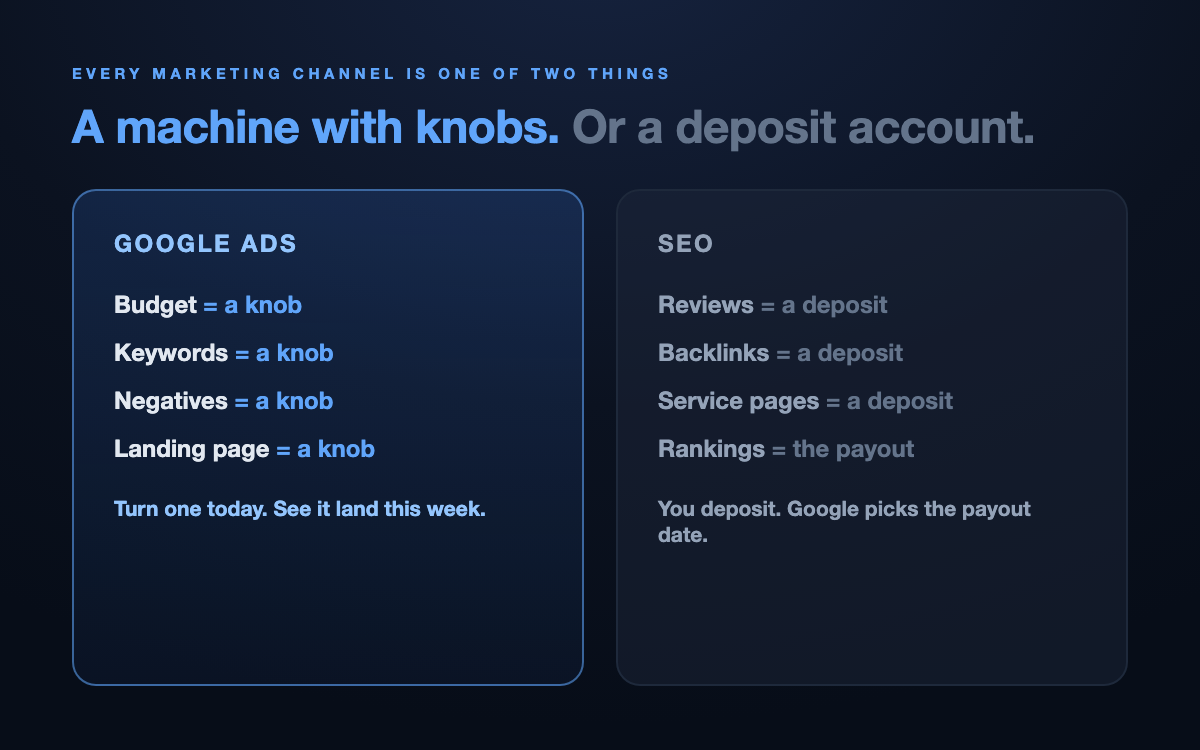
It’s either a machine with knobs. Or it’s a deposit account where somebody else decides when you get paid.
Google Ads is a machine with knobs. Budget is a knob. Keywords are a knob. Negative keywords are a knob. The page your clicks land on is a knob. When the numbers drift, you turn something, and you find out fast whether it worked.
SEO is deposits. Reviews are deposits. Backlinks are deposits. Good service pages are deposits. You make them every week, and then Google decides when, and whether, and how much to pay out. There is no knob. There is no “more organic, please, it’s a slow Tuesday.”
Neither one is bad. But only one of them can respond to what your calendar looks like this week.
We proved the knobs work with our own money
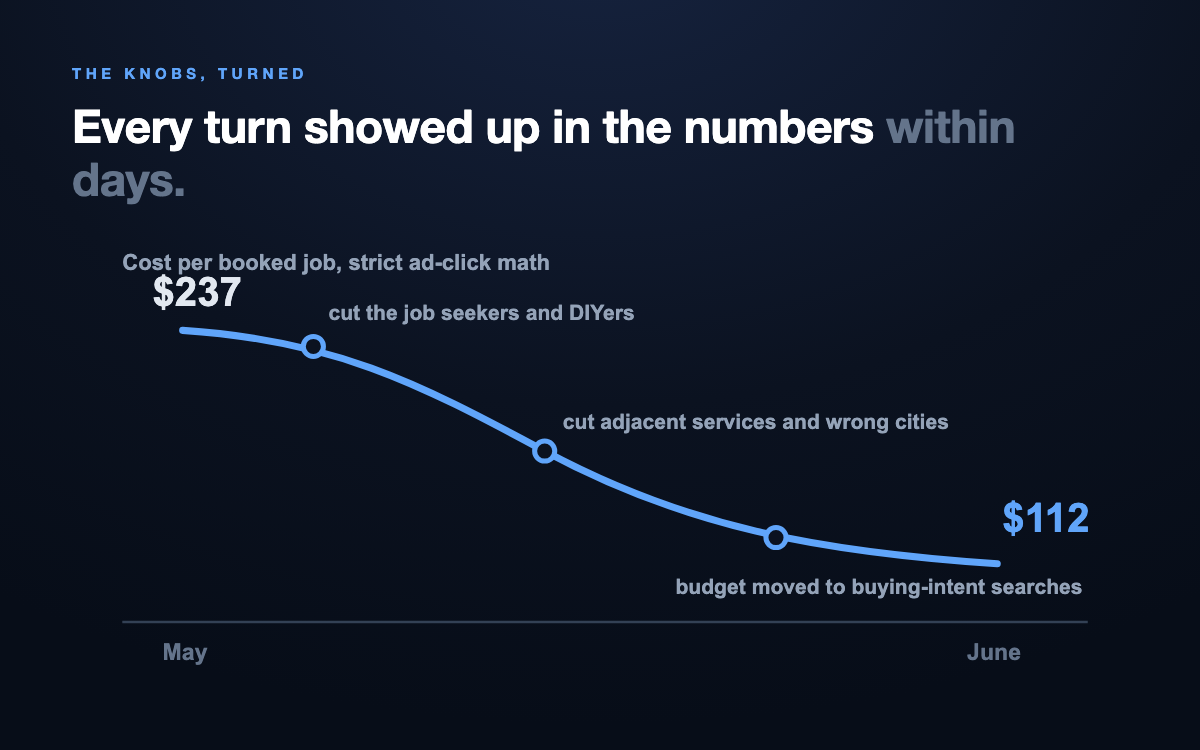
In the numbers post, we showed that Derek’s cost per booked job on strict ad-click math fell from $237 in May to $112 in June.
That didn’t happen to us. We did it. One negative keyword at a time, 544 of them now, each one a deliberate turn of a knob. Bad clicks got cut. Buying-intent clicks got the budget. The cost fell by more than half because of actions we took, and we could see each action land within days.
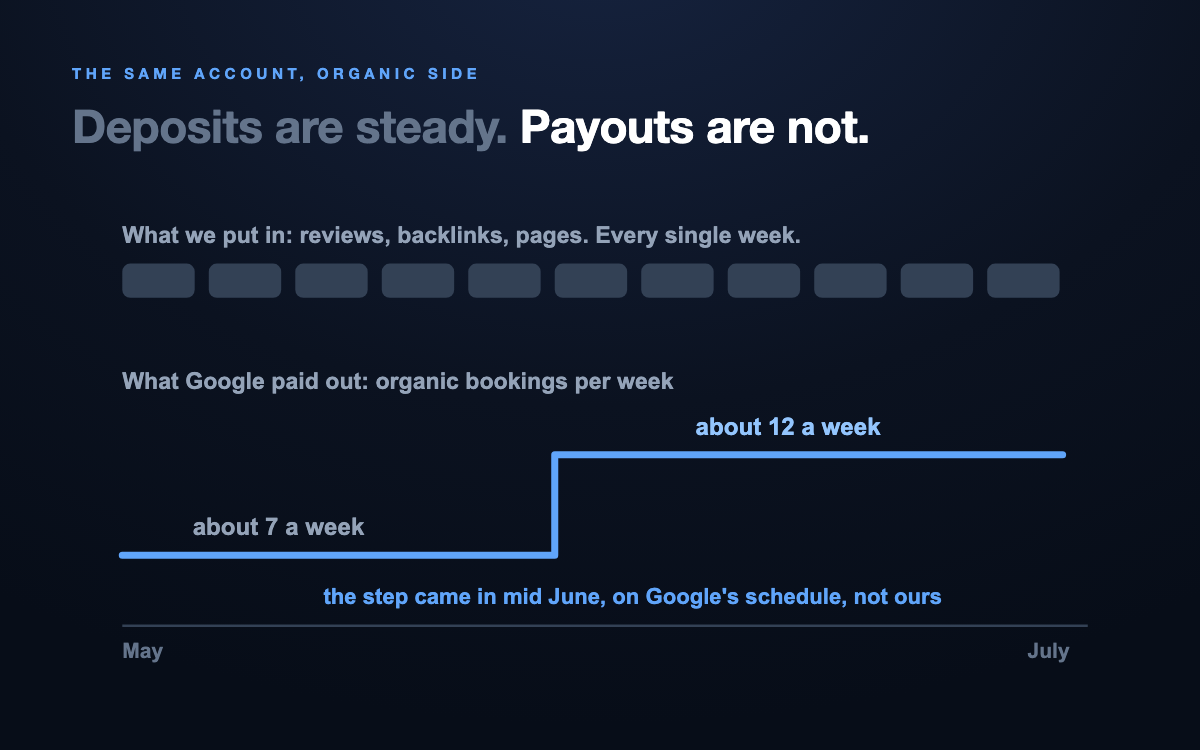
Now compare that to the organic side of the same account. Organic bookings stepped up from about 7 a week in May to about 12 a week since mid June. Great result. But here’s the honest part: we couldn’t have scheduled that step for a specific week if our lives depended on it. We made the deposits. Google picked the payout date.
The problem with “some guys are better at SEO”
They are. There are people who live and breathe this stuff and are genuinely great at it.
But here’s the thing nobody says out loud: even the best SEO people don’t control SEO. They’ve made more deposits, for longer, and they’re better at guessing the algorithm’s mood. That’s real skill. It’s still not a knob. When Google rolls out a core update, their rankings move too, and their whole playbook becomes “keep doing the right things and wait.”
Which leads to the most expensive ambiguity in local marketing.
You pay an SEO retainer for a year. Rankings barely move. Was the work bad? Was the market hard? Was it an algorithm update? You will never actually know. That’s not a knock on SEO guys. It’s the nature of a channel where nobody holds the knobs.
With ads, you know by Friday. The spend, the clicks, the booked jobs, all of it on one screen. If the person running your ads is wasting your money, the account shows it. If they’re good, the account shows that too. Accountability is only possible in a channel you can measure and steer.
Control includes the page the click lands on
One more piece of this, because it’s where most detail shop ad campaigns quietly die.
Running ads without controlling the landing page is paying for traffic you can’t convert. If every click lands on a five-year-old website with a contact form and no prices, no knob you turn inside Google Ads will save you.
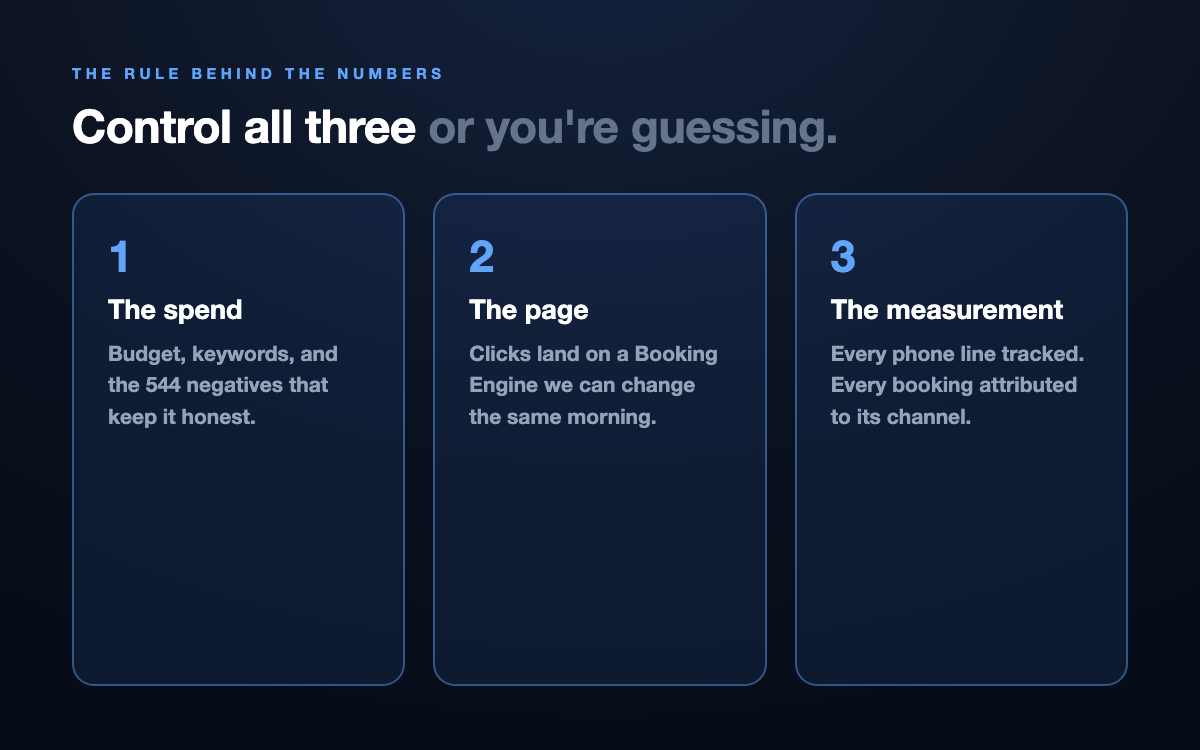
That’s why our rule is simple: we only run ads to pages we control. Not because a shop needs to throw out its website. Because when clicks cost money, the page they land on decides whether the math works. Your current site can stay right where it is. The ads land on the Booking Engine, where every phone line is tracked, every booking is attributed, and we can change a headline or a price the same morning we see a problem.
Control over the spend, control over the page, control over the measurement. That’s the whole system. Remove any one of the three and you’re back to guessing.
What this means for your shop
Put your money where the knobs are.
Run ads on the channel you can steer, and let the byproducts pile up in the channel you can’t. Every ad-funded job produces cash flow, a potential review, and a customer who knows your name. Those are the exact deposits SEO needs. The organic step-up happens on Google’s schedule either way. The difference is whether your calendar is full while you wait.
A shop that needs organic to work this month is gambling. A shop whose organic is funded by a full calendar is investing.
If you want to see the channel-by-channel proof, it’s in the full playbook. And if you want to see the page we send clicks to, build your Booking Engine free. It takes about three minutes, and it’s the same one Derek’s ads land on every day.
Want a system like this for your shop?
Build your site free →