We Spent $27,400 On Google Ads For One Detail Shop. Here Is Every Number.
Real numbers from a real detail shop: what a booked job actually costs on Google Ads, the 544 negative keyword playbook, and how paid ads lift organic, GMB, and direct bookings.

Everyone selling marketing to detailers has an opinion about SEO vs Google Ads.
Almost nobody shows you a real account.
Derek is a friend of mine with a detail shop in Seattle. We run his marketing: the ads, the tracking, the Booking Engine. Real shop, real money, real bookings. So instead of another opinion piece, here are the actual numbers, including the part where we were bad at this.
The short version
SEO is tomorrow’s money. PPC is today’s.
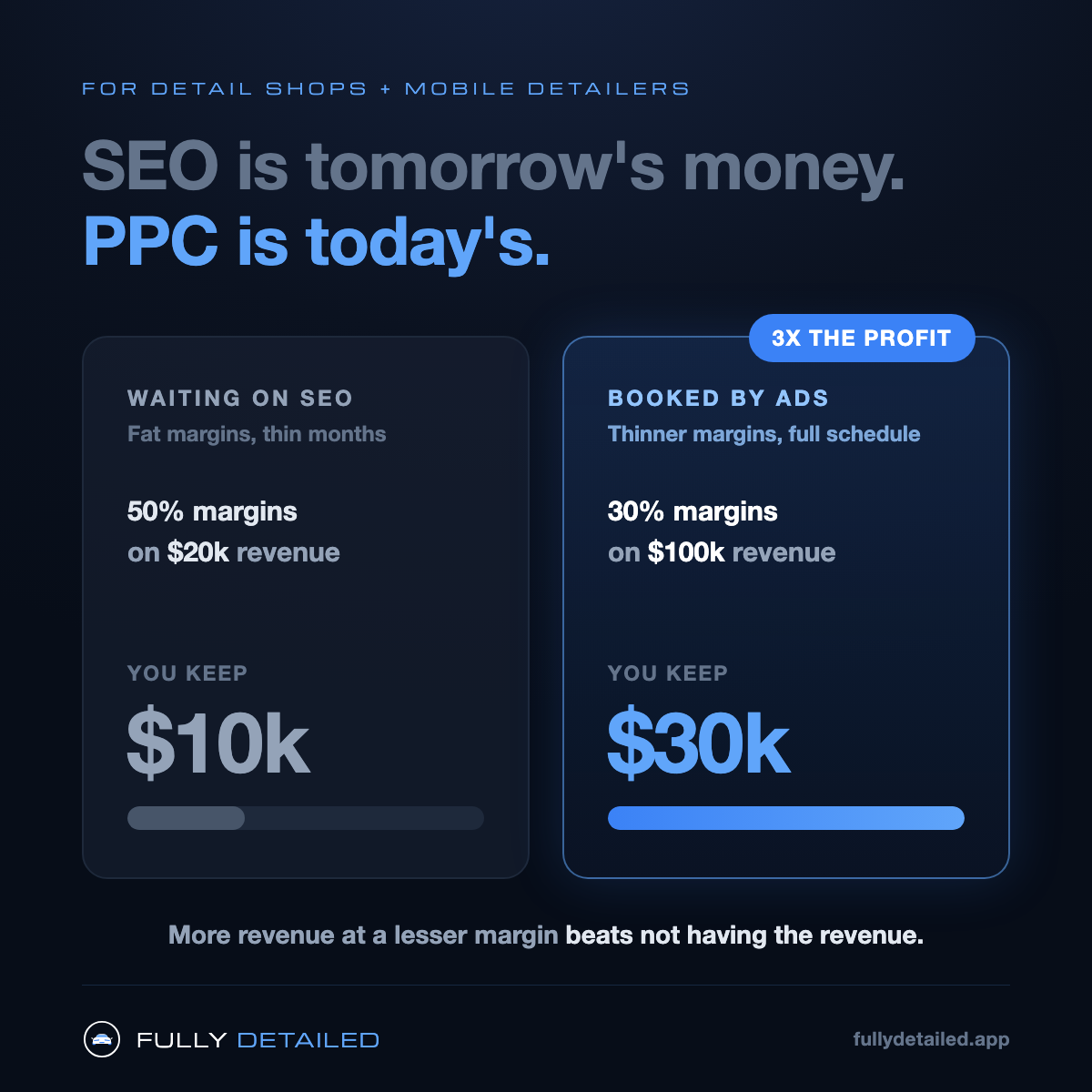
You cannot turn SEO on today and book jobs this week. Google Ads, you can. And more revenue at a lesser margin beats not having the revenue. Give me 30% margins on $100k over 50% margins on $20k every single time. One pays you $30k. The other pays you $10k. Margins don’t pay the bills. Dollars do.
That’s the argument. Now the receipts.
What a booked job costs right now
Before the table, one thing needs to be crystal clear:
These numbers are booked jobs. Not leads. Not form fills. Not “inquiries.” Jobs on the actual calendar, with a name, a vehicle, a service, and a time slot.
Most agencies quote you cost per lead, because leads are cheap and nobody follows up on what happens after. A lead is not revenue. A lead is homework. A booked job is a customer showing up.
Derek’s shop books through one system. Every job on the calendar gets counted, whatever channel it came from. Here is total Google Ads spend divided by total booked jobs, month by month:
| Month | Booked jobs | Ad spend | Cost per booked job |
|---|---|---|---|
| May | 243 | $6,880 | $28 |
| June | 229 | $6,929 | $30 |
| July (through the 21st) | 156 | $6,738 | $43 |
The average ticket is $248.
Read that again. Roughly $30 to $43 of ad spend per job on the calendar, and each job averages $248. Every day for the past week the number has been under $80. The best day was $27 per job with 12 jobs booked.
The honest part: we paid tuition
We were not good at this on day one.
There is plenty of information out there about running Google Ads. YouTube is full of it. None of it prepares you for doing it with real money. The first months of that $27,400 were tuition. Wrong keywords. Clicks from people who were never going to book. Spend that taught us things instead of booking jobs.
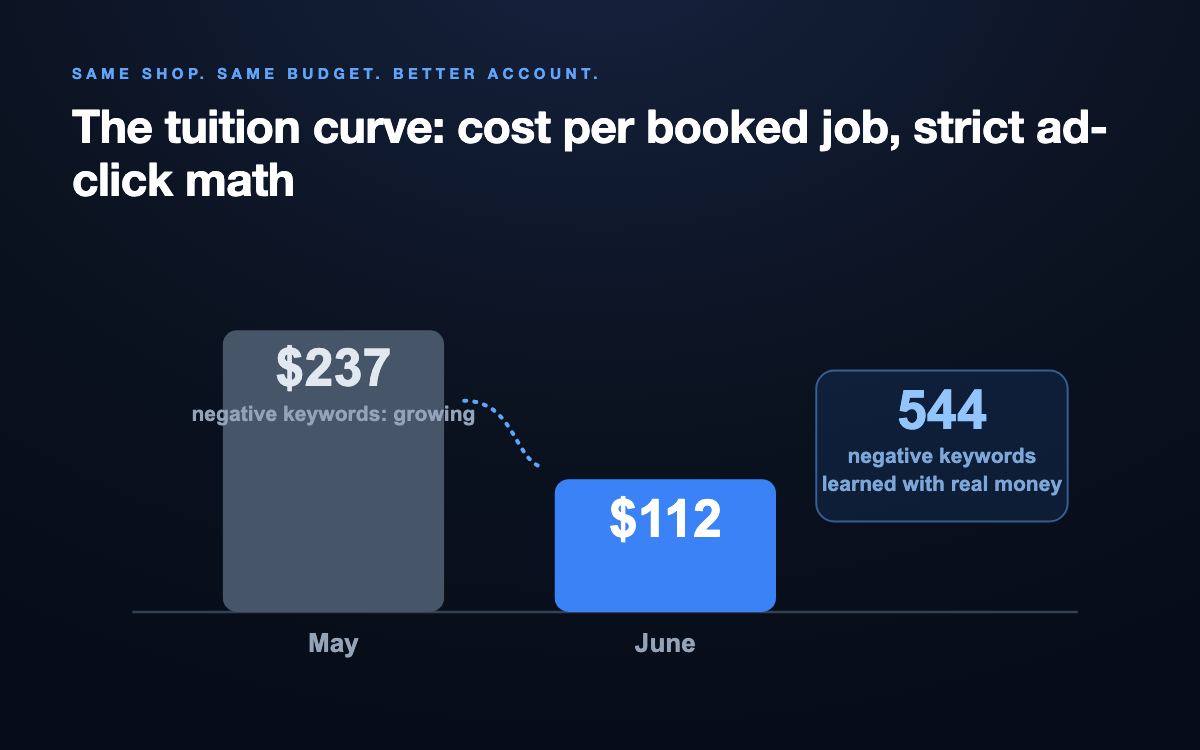
If you measure only the bookings that came from a direct ad click, the cost per job in May was $237. By June it was $112. Same shop. Same budget. Better account.
Why the numbers got better: negative keywords
When you start a Google Ads account, you have zero negative keywords. You show up for everything. And “everything” includes a lot of people who will never pay you.
People searching “how to detail a car” are learning, not buying. People searching “detailing jobs” want employment. People searching “cheap car detailing” will grind you on price. People searching “window tint” want a service you might not even offer.
Every week, you find the searches that spent your money and never booked, and you kill them. One at a time. With real dollars on the line.
Derek’s account now has 544 negative keywords. Words like free, cheap, diy, how to, jobs, training, salary. Adjacent services like dent repair, upholstery, powder coating. Wrong cities. Every one of them is a lesson that cost money to learn.
That list is why month three beats month one. The account stopped paying for bad clicks and started showing up only for searches with real buying intent. And honestly, the numbers got even better once we stopped tinkering with it every day and let the system work.
What does a booked job “really” cost? Three answers.
This is where most marketing content lies to you, so let’s not.
There are three ways to measure cost per booked job, and they give three different numbers:
- Google’s console. Google counts conversions its own way and misses bookings that happen off the click path. Do not run your business on this number.
- Strict last-click attribution. Only count a job if the last click before booking was literally your ad. On that basis, Derek’s cost per booked job is about $122 over the last 30 days. This is the harshest possible math.
- Business math. Total ad spend divided by total jobs on the calendar. That’s the $28 to $43 above.
The truth lives between #2 and #3, and closer to #3 than you’d think. Ads don’t just book the person who clicks. They put the shop’s name in front of people who search the brand later, call directly, or find the Google profile and book from there. Ads are the only paid channel in this account. The whole calendar rises when they run.
Even the harshest number, $122 to book a $248 job, works. And that’s before repeat visits.
Paid advertising raises every other channel. Here’s the proof.
Here’s the part the “SEO vs PPC” debates miss. Ads don’t just book the person who clicked. They lift the whole account.
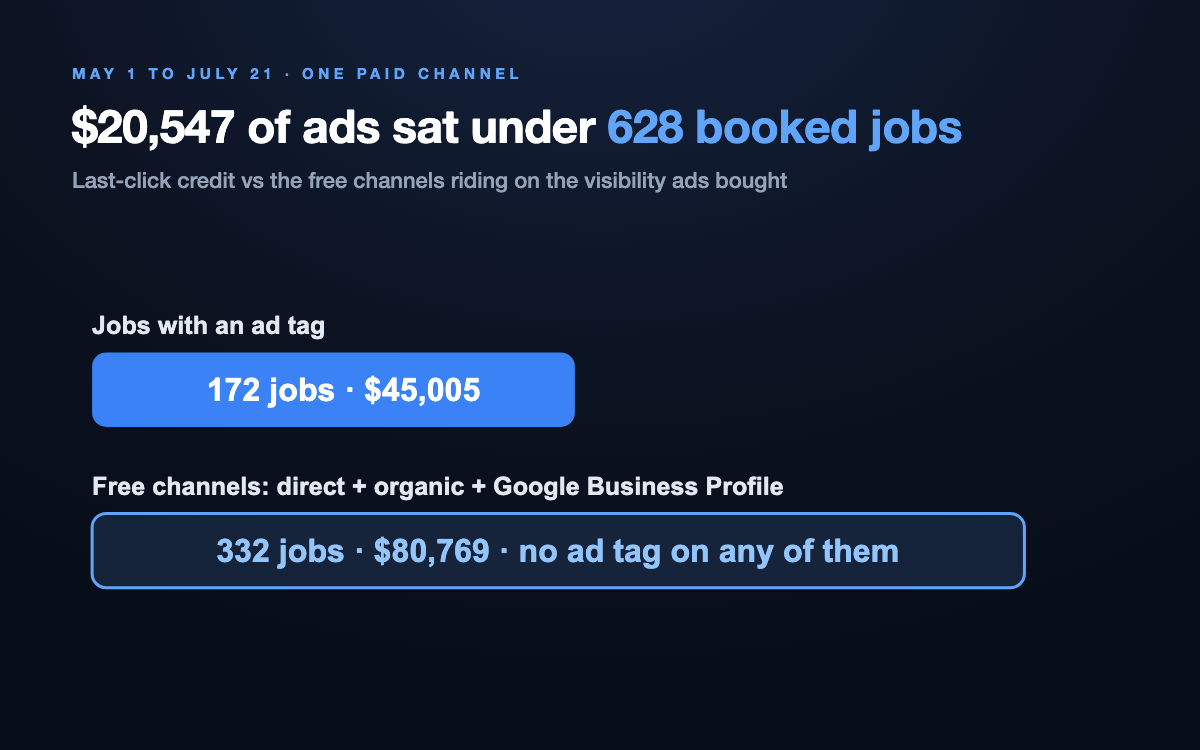
Same window, May 1 through July 21. One paid channel. $20,547 in ad spend. Here is where all 628 booked jobs came from.
Quick note on how clean this tracking is: every phone line is attributed separately. Calls to the number on the Google Business Profile count as GBP. Calls to the ad call extension count as Google Ads. Calls to the website number count as direct. Most shops have no idea which line their phone rang from. This one does.
| Channel | Booked jobs | Booking value |
|---|---|---|
| Direct (typed the name in, called the website line, came back later) | 174 | $41,427 |
| Google Ads (ad click or ad call extension) | 172 | $45,005 |
| Google Organic | 92 | $23,472 |
| Walk-in / shop intake | 80 | $16,162 |
| Google Business Profile (including its phone line) | 48 | $11,725 |
| Bing and DuckDuckGo organic | 18 | $4,145 |
| Email, Groupon, Yelp, everything else | 44 | $11,631 |
| Total | 628 | $153,567 |
Ads get direct credit for 172 jobs. But look at the top of that table.
The single biggest channel is Direct. 174 people who typed the name in, called the shop’s own number, or came back on their own. Where does that come from for a local detail shop? People who saw the name somewhere first. Then Google Organic at 92, the Business Profile at 48, Bing and DuckDuckGo at 18. All of it landing on a shop with 480+ Google reviews, and those reviews came from jobs, and a huge share of those jobs came from ads.
Add up the free channels: organic search plus the Business Profile plus Direct is 332 booked jobs worth over $80,000. None of those carry an ad tag. Nearly double what the ads get direct credit for, riding on the visibility the ads paid for. That’s the flywheel:
- Ads fill the calendar this week.
- A full calendar generates cash flow and reviews.
- Reviews and name recognition pull up every free channel: organic, maps, direct.
- Now the ads are the floor, not the whole building.
Derek’s monthly booking value went from around $20k before the system to around $48k now. Not because we picked SEO or picked ads. Because ads paid for the time everything else needed.
The honest part, round two: organic stepped up, then stalled
We’re not going to pretend the flywheel spins on its own forever.
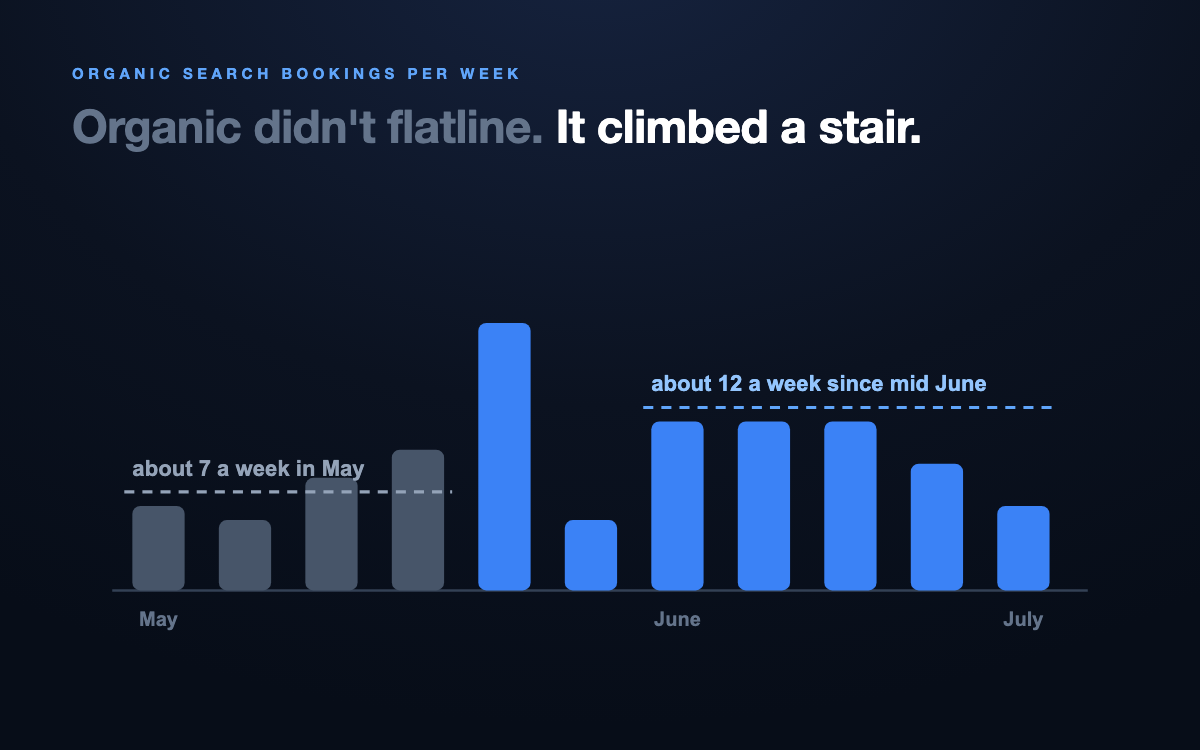
Here’s what organic actually did. Through May, organic search booked about 7 jobs a week. In June it stepped up to about 12 a week and held there. That step is the flywheel working: more jobs, more reviews, better rankings, more organic bookings.
But it’s been sitting on that stair for about six weeks now. Up from May, yes. Climbing week over week, no. Part of that is the day-to-day volatility on Google Ads. When paid has a rough week, the halo channels feel it too, which tells you how connected they really are.
Getting to the next stair is the current work, and it’s a deliberate SEO plan, not a wish:
- Keep the review engine running. More good reviews, every week, without begging.
- Build backlinks so the site earns authority instead of renting visibility.
- Keep publishing pages that answer what buyers actually search for.
SEO is a strategy you invest in on purpose, with ads funding the runway. If you want the channel-by-channel breakdown of everything working in his account right now, that’s the full playbook.
What this means if you own a detail shop
You have two options.
Option one: run this playbook yourself. It works. Budget for the tuition, because you’ll pay it the same way we did: one bad click at a time, while you figure out your negative keywords with your own money.
Option two: start with the list of 544 already in place, the campaign structure already proven, and the Booking Engine already built to convert the clicks. Month one performs like our month three, because the tuition is already paid.
That second option is what we do. We’re taking on 10 detail shops to run this exact playbook: the ads, the SEO foundation, the review engine, and a Booking Engine that turns clicks into jobs on your calendar. Same system, same math you just read.
If you want to be one of the 10, start where every shop starts: build your Booking Engine free. It takes about three minutes, and it’s the same system converting Derek’s clicks into the calendar you just read about.
We see every build that comes through. If your shop looks like a fit for the full playbook, you’ll hear from us.
Every number in this post comes from first-party tracking: the shop’s own booking database and its Google Ads account, pulled July 22, 2026. Nothing is projected, rounded up, or “estimated based on industry averages.”
Want a system like this for your shop?
Build your site free →