The AI Answered 1,500 Calls For An Owner Who Still Doesn't Trust It
Voice AI booked 230 jobs worth $53,000 at one detail shop. The owner still doesn't like it. Here's why missed calls cost shops more than they think, with the real numbers.

Here’s the most honest thing we can tell you about Voice AI.
Derek still doesn’t like it.
The AI on his phone line has answered over 1,500 calls. It has put 230 booked jobs worth more than $53,000 on his calendar. And to this day, he doesn’t fully trust it. He wants to hear the calls himself. He wants full control of every quote.
If you own a shop and you just nodded, this post is for you.
Owners don’t miss calls because they’re lazy
Let’s kill this idea first, because every marketing pitch about missed calls quietly implies the owner doesn’t care. Wrong.
Derek misses calls because he’s running a shop. When you’re backing a customer’s car out of a bay and the phone rings, guess what happens? It rings. When your hands are wet, when you’re walking a customer through their invoice, when you’re halfway under a tailgate with a steamer, the phone loses. Every time.
That’s not laziness. That’s physics. One person cannot answer a phone and run a shop at the same time, and most detail shops are one person deep at the front.
The part nobody sees: missed calls leave no receipt
When you lose a job you quoted, it stings. You saw it get away.
A missed call is worse, because you never see it at all. There’s no invoice for the job you didn’t book. No line item for the caller who tried you first, got voicemail, and booked with the shop down the street. The loss is completely invisible, which is exactly why owners underestimate it.
We can make it visible, because every phone line at Derek’s shop is tracked.
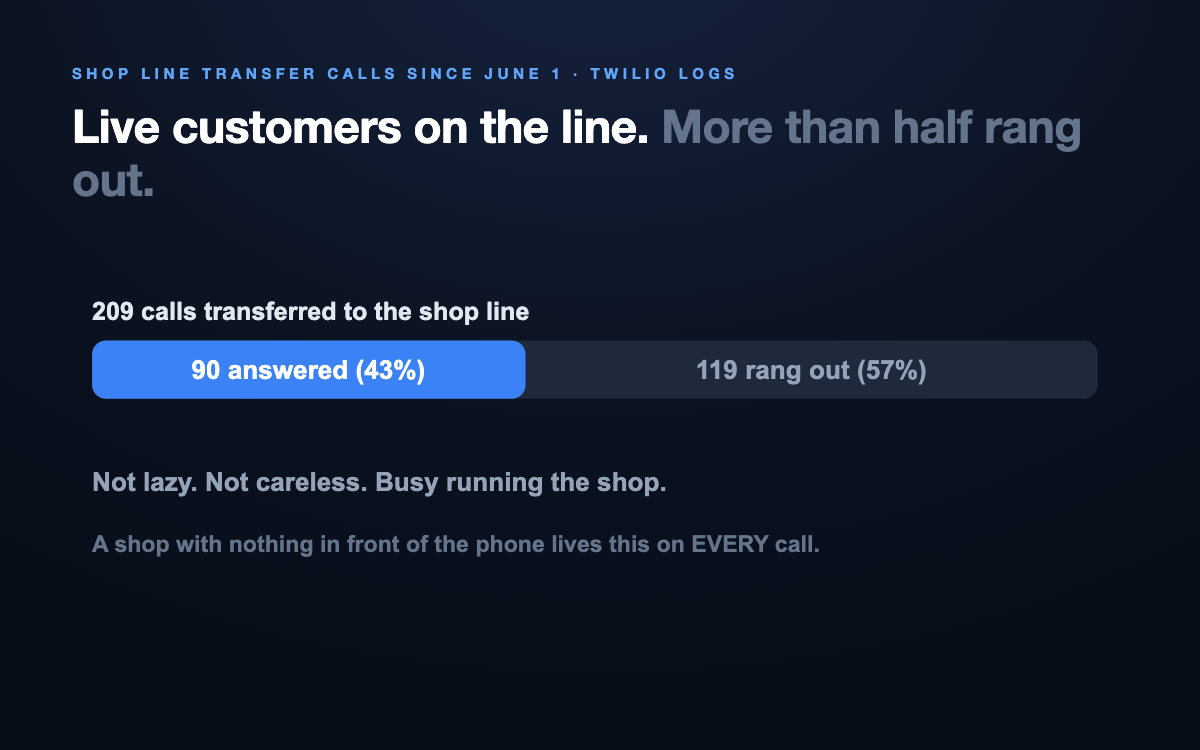
When the AI takes a call from someone who wants a human, it transfers them to the shop line. Since June 1, the shop line got 209 of those transfer calls. It answered 90.
The shop missed 57% of its own transfer calls. Live customers, already on the line, already warm. More than half rang out. Not because anyone was lazy. Because everyone was working.
Now think about a shop with no AI in front of the phone at all. That 57% is what happens to every call.
What the net actually catches
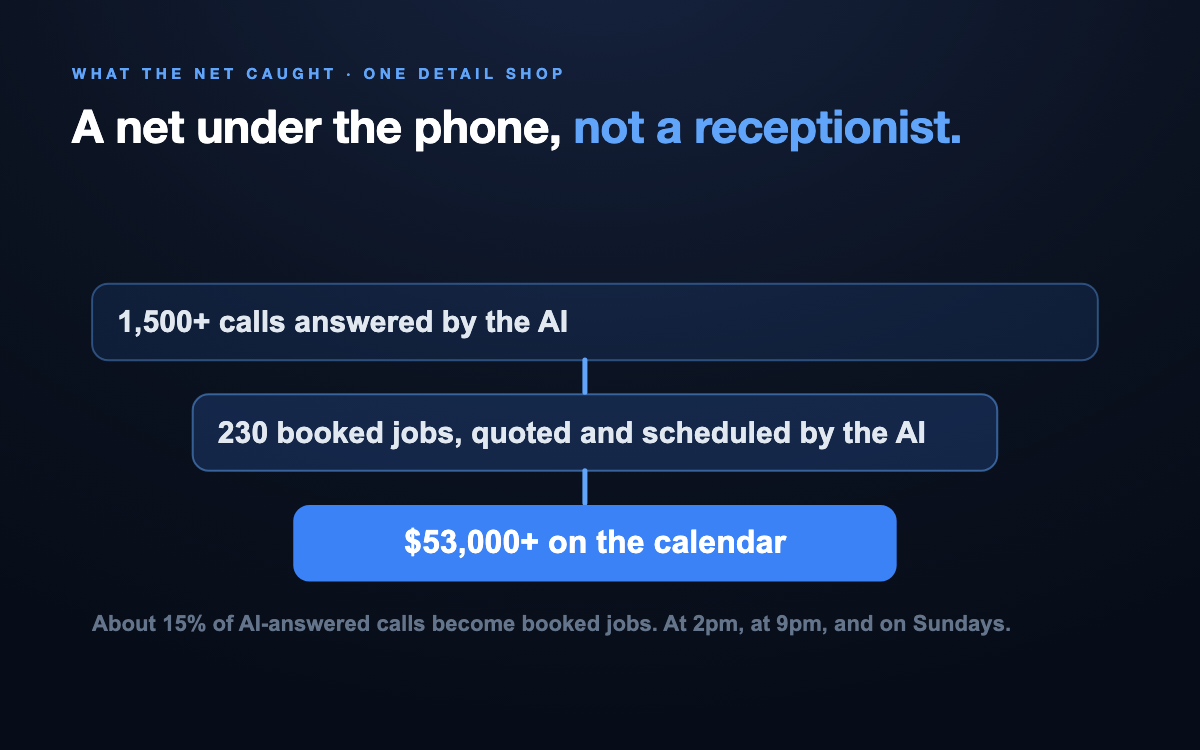
The Voice AI is not a receptionist replacement. It’s a net under the phone. Here’s what the net has caught at one shop:
Roughly 15% of AI-answered calls turn into a booked job with a name, a vehicle, and a time slot. The AI quotes real prices from the shop’s own service menu, checks the calendar, and books the slot. At 2pm and at 9pm. On a Sunday. While the owner is moving a car.
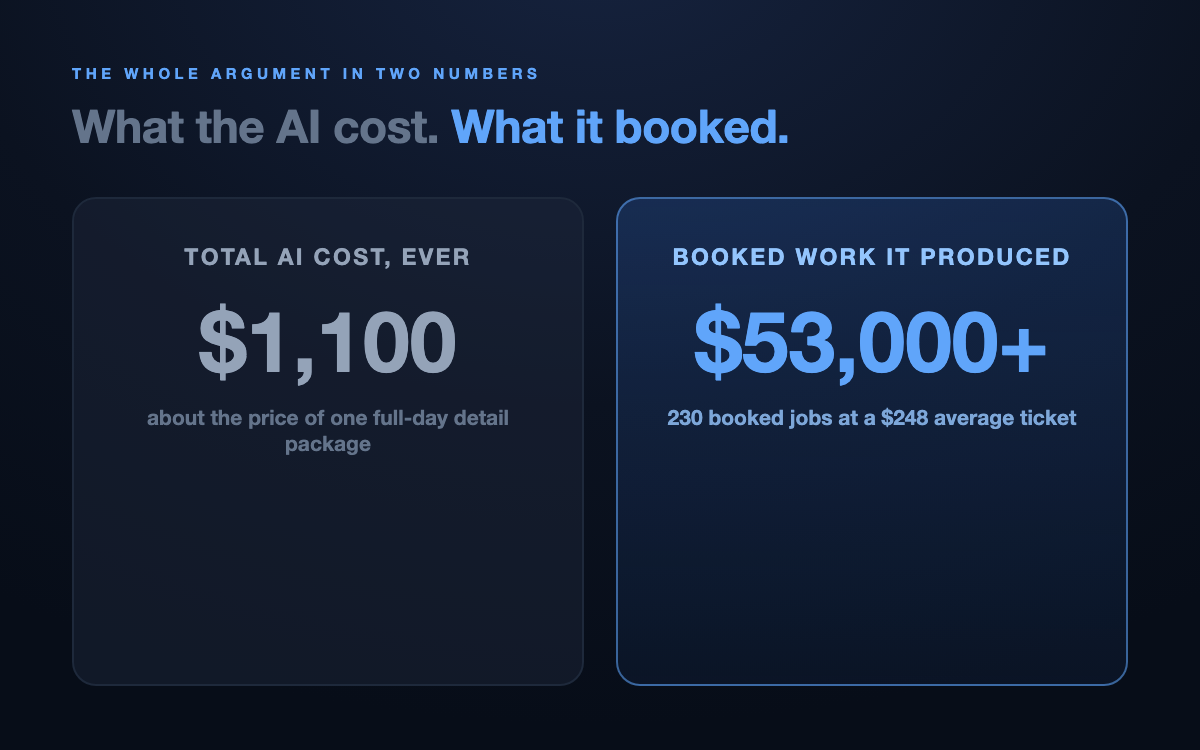
And the running cost of the AI so far is about $1,100 total. Against $53,000 in booked work. That is not a typo.
The control paradox
Here’s the tension we see with almost every owner, and Derek is the perfect example.
He wants full control. He wants to quote every job himself, his way. He is protective of his pricing, his process, his customers. Every good owner is.
But control has a physics problem. You cannot control a phone call you never answered. The owner who insists on handling every call personally isn’t choosing control over automation. He’s choosing the 43% of calls he can physically get to, and donating the rest to whoever answers next.
The AI doesn’t take control away from an owner. The missed calls already took it. The AI just picks up what was falling on the floor.
The honest limits
Voice AI does not completely fix the phone.
Some callers hang up on it. Some want the owner and nobody else. And as the transfer numbers above show, when a caller does want a human, the human is still busy more than half the time. We publish those numbers on purpose. Anyone who tells you an AI answers everything and books everyone is selling you a demo, not a system.
What it does, provably, is book a pile of jobs that a busy one-person front desk was never going to catch. At Derek’s shop that pile is 230 jobs and counting, at an average ticket of $248.
What this means for your shop
Do the honest math on your own phone. If you’re like most shops, about half your inbound rings out. Every one of those calls was someone ready to spend money on their car, and every one is a coin flip you lose by default.
You don’t have to like the AI. Derek doesn’t. You just have to stop donating booked jobs to the shop down the street.
The phone net is part of the same system from the full playbook, sitting behind a Booking Engine that catches the clicks the same way the AI catches the calls. If you want to see it with your shop’s name on it, build your Booking Engine free. It takes about three minutes.
Numbers pulled July 22, 2026 from the shop’s own call and booking database: 1,500 AI-answered calls, 230 booked jobs worth $53,788 linked to those calls, and Twilio’s own logs for the shop-line transfer stats (209 transfer dials since June 1, 90 answered). Nothing estimated.
Want a system like this for your shop?
Build your site free →